TL;DR
Most strategies do not fail because the ideas are weak. They fail because reality shows up and nobody adapts fast enough. Roughly 90% of strategies never achieve their intended outcomes, not due to lack of intelligence, but because assumptions go stale, execution drifts, and teams mistake activity for progress.
In this article, I’ll walk you through why strategy breaks down, what it truly costs marketers, and a practical framework you can use to spot misalignment early, course-correct fast, and keep your strategy alive in the real world.
Recognizing the Moment Every Marketer Knows
It happens when you’ve just finished the strategy doc and lean back in your chair thinking, Yeah, this is solid. The funnel makes sense. The audience feels clear. The launch timeline looks reasonable. You can already imagine the Slack messages celebrating the results.
Then Monday happens.
- The designer gets pulled into a different project.
- Sales wants a last-minute adjustment to the messaging.
- Leadership asks if this campaign can somehow also support three other goals.
Meanwhile, the audience you were confident about barely reacts.
If you’ve ever:
- Launched a campaign that looked perfect internally but fell flat publicly
- Spent weeks planning only to rush execution at the finish line
- Watched priorities shift mid-sprint and quietly break the plan
You’re not bad at strategy. You’re just experiencing reality.
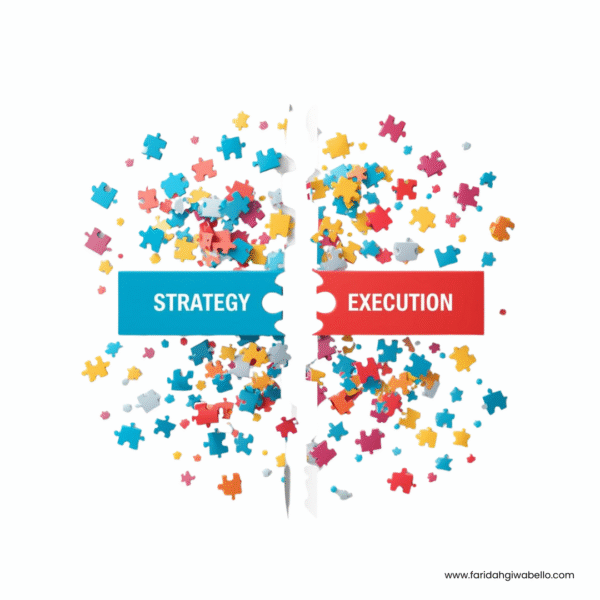
Think of it like setting up dominoes perfectly across the floor and then someone walks through the room before you’ve finished. Strategy rarely fails because the idea is weak. It fails when execution collides with changing priorities, limited time, and human behavior.
Research consistently backs this up. Around 67% of well-formulated strategies fail due to execution issues, while more than 80% of strategic initiatives do not fully reach completion. Not because teams lack intelligence, but because translating plans into coordinated action is genuinely hard.
This is not limited to large organizations with too many meetings. Solo marketers feel it when they over-plan and under-ship. Startups feel it when growth assumptions meet real users. Small teams feel it when execution depends on everyone wearing five hats.
Once you see this pattern clearly, the real question becomes: what exactly causes strategies to break down in practice?
Why Strategies Break Down (Even the Smart Ones)
Audience Assumptions Are Outdated
Markets move faster than decks. What resonated six months ago might feel tone-deaf today. Customer needs shift, language evolves, and attention moves. Yet many strategies are still built on static personas and old research.
McKinsey reports that companies that regularly refresh customer insights outperform peers by up to 85% in sales growth. Translation: if your understanding of the audience is stale, execution will feel confusing because you are optimizing for a version of people that no longer exists.
You will see this show up as:
- Low engagement despite “good content”
- Campaigns that technically launch but emotionally flop
- Teams arguing about messaging instead of learning from users
Think of it like trying to play a video game with the wrong controller. Everything feels off, and your moves do not land.
Previous Tactics Stop Working
Success can create blind spots. Channels saturate, algorithms change, competitors copy your playbook, and economic conditions shift. Suddenly, the tactic that carried your last quarter does nothing.
Nielsen research shows returns on marketing spend decline sharply when brands over-rely on the same channels without experimentation. Familiarity feels safe, but it quietly kills performance.
If your strategy assumes repeat success without revalidation, execution feels like pushing a car uphill while someone steals your spare tires.
External Forces Disrupt Plans
Competitors suddenly launch faster than expected, regulations shift mid-stride, budgets get cut, and inflation quietly reshapes how people buy.
According to Deloitte, digital and emerging technologies, changing market conditions, and regulatory pressures are common external forces that drive strategic pivots.
The problem is not disruption. The problem is clinging to a strategy that no longer fits the environment. It is like bringing an umbrella to a hurricane. Good intention, wrong approach.
Research Gaps Create Blind Spots
Strategy built on “this should work” instead of evidence almost always cracks during execution. Teams skip validation because it feels slow. But guess what is slower? Recovering from a misaligned launch.
Close to 35% of startup failures happen because there is no real market need. That is not a strategy problem. That is an assumption problem.
Planning Cannot Replace Progress
This is the sneakiest one. You plan beautifully, organize folders, and outline workflows. Everyone feels busy.
But nothing meaningful moves. Execution does not respond to intention. It responds to action. It is like building a gym in your backyard and never showing up to lift.

What Strategy Failure Really Costs Marketers
Trust Erodes Before Budget Does
When strategies do not translate into results, stakeholders stop believing in the process.
For example: You pitch a growth plan with clear projections. The team rallies. Three months later, results are unclear and updates sound vague. Next time you propose a strategy, leadership asks for something safer or reduces scope preemptively.
Over time:
- Fewer greenlights
- Smaller bets
- More oversight and second-guessing
Strategy failure quietly turns marketers from decision-makers into order-takers. It is like a bridge that keeps cracking. People will hesitate to cross it, no matter how sturdy it seems on paper.
Teams Optimize for Visibility, Not Impact
When execution lacks clarity, people work on what looks productive instead of what is productive.
For example: A marketer spends hours designing dashboards, refining reports, and polishing decks because those are the things leadership sees. Meanwhile, experiments that could move performance never happen.
The result:
- Work becomes performative
- Metrics become cosmetic
- Outcomes take a back seat to optics
This is like running on a treadmill. Lots of motion, no forward progress.
Signals Are Ignored
Repeated strategy failures train teams to dismiss feedback.
For example: A campaign underperforms. Instead of digging into why, the team shrugs. No post-mortem. No insight. Just quiet acceptance.
Over time:
- Data becomes noise
- User feedback is dismissed
- Weak signals go unnoticed
Eventually, even good insights do not lead to action. Like ignoring smoke until the fire is too big to contain.
Momentum Becomes Caution
Execution breakdowns slow teams and make them hesitant.
For example: After failed launches, extra approvals, longer timelines, and contingency planning are added. Every new idea has to justify itself ten times over.
The result:
- Speed disappears
- Creativity shrinks
- Competitors move faster
The fear of failure creates the conditions that guarantee it. Like wrapping yourself in bubble wrap before trying to run a marathon.
Morale Suffers
When plans fail consistently, people stop caring.
For example: Team members nod along in strategy meetings but do not feel urgency. Execution feels optional because history says it probably will not matter.
The result:
- Quiet disengagement
- Minimal ownership
- Just tell me what to do energy
Strategy is no longer direction. It is background noise.

How Great Brands Made Execution Their Advantage
Great brands aren’t magically better at strategy. They’re better at doing the work when it’s inconvenient.
Netflix: Testing Over Guessing
Netflix doesn’t rely on intuition for growth decisions. They test relentlessly.
Before major interface or content changes, Netflix runs controlled experiments on small user segments, measuring retention and engagement before rolling anything out broadly. This execution-first mindset helped Netflix grow to 260+ million subscribers globally while many competitors struggled to adapt.
The strategy was experimentation. The advantage was discipline.
HubSpot: Operationalizing Content Strategy
HubSpot didn’t just say “we’ll do content marketing.” They built systems around it.
They documented processes, assigned ownership, tracked outcomes, and optimized relentlessly. As a result, inbound marketing became a repeatable growth engine that helped HubSpot scale to $2B+ in annual revenue.
The difference wasn’t ideas. It was execution infrastructure.
Slack: Listening, Then Shipping
Slack’s early growth wasn’t driven by flashy campaigns. It came from obsessive feedback loops.
The team monitored user behavior, responded directly to complaints, and shipped improvements quickly. This tight execution-feedback loop helped Slack grow from internal tool to a platform used by millions of teams worldwide.
They didn’t wait for perfect strategy. They adjusted through execution.
These brands treated execution as a learning system, not a finish line.
A Framework to Keep Strategy Aligned With Reality
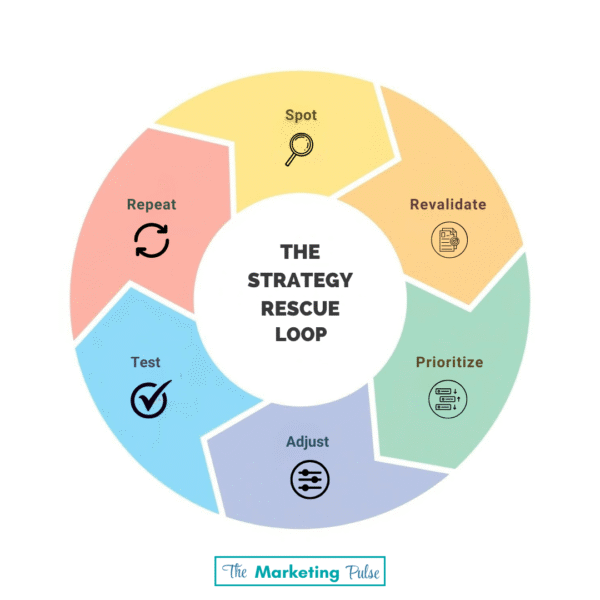
Here’s a simple framework you can use as a marketer at any level:
Step 1: Spot the Misalignment
Goal: Identify exactly where reality differs from the plan.
How to do it:
- Look at your metrics vs. projections. Are key KPIs missing the mark?
- Gather qualitative feedback: customer complaints, social sentiment, team observations.
- Ask the hard questions:
- Which parts of the plan aren’t working?
- Where is the team struggling to execute?
- What’s confusing the audience?
- Which parts of the plan aren’t working?
Step 2: Revalidate Assumptions
Goal: Test whether your initial hypotheses still hold.
How to do it:
- Revisit your audience research: are the personas still accurate? Has user behavior shifted?
- Audit market and competitor changes: new competitors, updated regulations, or platform algorithm changes could affect your plan.
- Question internal assumptions: deadlines, dependencies, and team capacity may have changed since you wrote the strategy.
Step 3: Prioritize Interventions
Goal: Decide which course corrections will have the biggest impact.
How to do it:
- List all issues discovered in Steps 1 and 2.
- Rank them by impact vs. effort. Focus on fixes that move the needle fast.
- Avoid trying to fix everything at once. One high-impact adjustment often outperforms five low-impact tweaks.
Step 4: Adjust Actions & Ownership
Goal: Realign the team and tasks to implement your fixes effectively.
How to do it:
- Translate each prioritized fix into a specific action. Avoid vague “improve engagement”, make it tangible.
- Assign clear ownership: one task, one owner. No ambiguity.
- Update timelines and dependencies — make deadlines realistic given the adjustments.
- Communicate changes clearly with the team and stakeholders.
Step 5: Test, Learn, Iterate
Goal: Treat adjustments as experiments. Learn fast, adapt, and repeat.
How to do it:
- Launch small, measurable experiments first. For example, A/B test a new landing page CTA instead of overhauling the entire page.
- Track metrics continuously, not just at the end. Use dashboards, alerts, or simple spreadsheets.
- Review results quickly: what worked? What didn’t? Why?
- Feed insights back into your strategy, loop back to Step 1.
Why This Works
- Prevents small issues from turning into failed launches.
- Focuses on learning in real time, not waiting until the end of a quarter to realize failure.
- Ensures the team stays aligned, accountable, and motivated.
- Turns strategy from a static plan into a living, adaptable process.
The Mindset Shift That Makes Execution Stick
Execution thrives on clarity, not pressure.
If the next step isn’t obvious, momentum dies. If ownership is vague, accountability disappears. If priorities change weekly, nothing compounds.
I learned this the hard way early in my content career. I once planned a multi-channel campaign that looked incredible on paper. Emails, social posts, partnerships. But I ignored my own limits. Half the plan never shipped.
The strategy wasn’t wrong. The structure protecting execution was missing.
Strategy Is Potential Energy
Strategy without execution is theory. Execution without strategy is chaos.
If you want your next plan to actually work, don’t write a smarter strategy. Build a system that lets strategy adapt to reality.
That’s how you stop strategy from betraying you and start making it work for you.
Next Steps
- Download this ready-to-use Notion strategy-to-execution tracker to streamline your implementation
- Sign up for The Marketing Pulse for real-world strategy insights, examples, and execution-ready takeaways.