TL;DR
Overthinking feels responsible, but it actually slows everything down. When you pile on options, contingencies, and “just in case” ideas, nothing ships and no one knows what matters. The brands that win don’t do more, they choose better. Best Buy turned itself around by focusing on a few priorities, not chasing everything.
Value happens when people instantly understand why something matters. Overthinking delays that moment or kills it completely.
The fix isn’t a perfect plan. It’s a decision. Pick one thing, strip out the noise, commit, and move. Momentum beats complexity every time.
Why Your Best Ideas Are Dying from Overthinking
You know that friend who can’t pick a place to eat because they’re checking every menu, asking the group chat for opinions, worrying about prices, wait time, and whether anyone might not like it?
That’s your marketing strategy right now.
The fastest way to kill a good idea isn’t by never executing it. It’s by drowning it in five more “good ideas” before it ever sees daylight.
The Overcomplication Epidemic
Here’s the uncomfortable truth: complexity feels like strategy. It feels thorough, like you’ve done your homework.
But complexity is actually strategy’s silent assassin.
Think about the last time you opened your project management tool:
- How many initiatives are still in “planning” status?
- How many campaigns have been “almost ready” for three months?
- How many meetings have you sat through where everyone agreed something was important, then spent the next hour debating details that stopped anyone from actually starting?
That’s not strategy. That’s paralysis wearing a business suit.

Why Best Buy’s Turnaround Matters
Best Buy is a U.S. consumer electronics retailer with hundreds of big box stores and a major online presence. It is a place millions go for gadgets, appliances, and tech services.
In the early 2010s, the company was struggling amidst fierce competition and declining sales. Under CEO Hubert Joly, Best Buy executed a focused turnaround strategy called Renew Blue. Instead of chasing every opportunity, they committed to a handful of priorities, and it paid off.
Between late 2012 and 2017, the company’s stock price rose roughly 213% while the broader retail market grew more slowly.
They cut massive costs, improved customer experience, strengthened their e-commerce model, and reinvigorated vendor partnerships, all through disciplined choice rather than complexity.
The signal is clear: clarity often outperforms complexity in the real world.
What Value Realization Really Means
Value realization is the precise moment someone first feels why your product, service, or idea matters.
For Slack, it’s when you send your first message and get a reply instantly.
For Dropbox, it’s watching your file appear on another device.
For a meditation app, it’s finishing a session and feeling calmer.
But value realization applies to more than products.
Your customer experiences it when they instantly understand how you solve their problem.
Your team experiences it when they grasp what success actually looks like.
You hit it when you stop adding contingencies and just decide.
The problem is that we bury these moments under layers of “what ifs” and “we should alsos.”

The Real Cost of Overthinking
Here’s what overcomplication costs you.
- Time: Every extra layer adds days or weeks to execution. That competitor shipping faster isn’t smarter. They’re more decisive.
- Clarity: When you optimize for five goals at once, your team doesn’t know which one matters. So they optimize for none.
- Confidence: The more variables you try to control, the less control you actually have.
- Value realization: Most critically, you delay or destroy the instant when your customer, team, or stakeholder gets it. By the time they wade through all your qualifiers, they’ve lost interest.
A good joke explained is a dead joke. A clear strategy over-qualified is a dead strategy.
The UPSIDE DOWN Framework
When you’re stuck in overthinking mode, you need a system that flips your thinking. That’s the UPSIDE DOWN framework.
This isn’t about finding the perfect decision. It’s about getting unstuck.
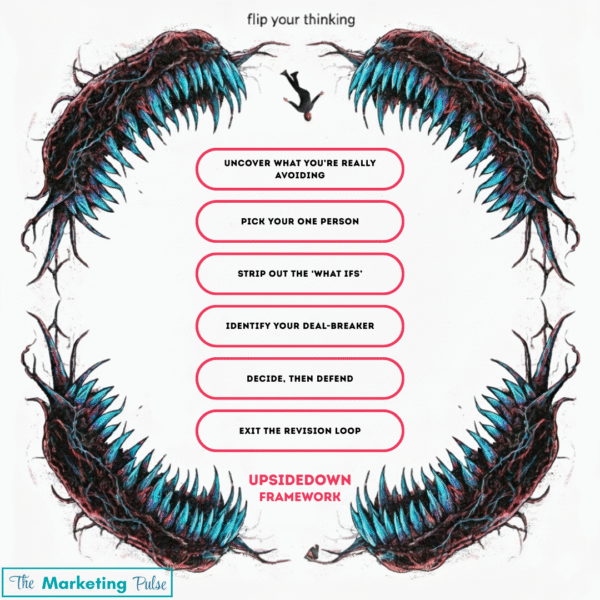
- Uncover What You’re Really Avoiding
Name the fear. Most “strategic considerations” are fear wearing a business suit.
- Pick Your One Person
Decide for a specific human, not a vague segment.
- Strip Out the “What Ifs”
Focus on what you know for sure right now.
- Identify Your Deal Breaker
Define the one outcome that would make this a total failure and protect against it.
- Decide, Then Defend
Choose first. Build your rationale after.
- Exit the Revision Loop
Two revisions maximum. More is just rearranging deck chairs.
How to Use This Framework Today
Pick one decision you’ve been sitting on. It might be a campaign direction, positioning statement, feature prioritization, or vendor choice.
Spend twenty minutes working through UPSIDE DOWN. One answer per letter. Two sentences maximum each.
By the end, you’ll either have your answer or you’ll realize you don’t have enough information. That realization itself is a decision about what to do next.
The goal isn’t perfection. It’s momentum.
The Pattern You Need to See
Every overcomplicated strategy follows the same pattern.
A clear idea emerges. Then the “yes, ands” begin. Then stakeholder additions. Then contingency plans. Then alternative approaches. Eventually, no one remembers what the original goal was.
Best Buy didn’t save itself through complexity. They saved themselves by choosing what mattered and cutting everything else.
Value realization for you, your customer, and your team depends on clarity that comes from choosing, not endlessly considering.
The Question That Changes Everything
Ask yourself: “If I only moved one number this month, which one would actually matter?”
That’s your priority. Everything else is distraction dressed up as strategy.
Overthinking isn’t a flaw. It’s how the brain protects itself from the vulnerability of commitment. But that protection is expensive. It costs speed, clarity, and the ability to create moments that matter.
So flip your thinking. Use the framework. Make the call.
Because complexity isn’t killing your ideas. Your refusal to let them stay simple is.
Next Steps
- Sign up for The Marketing Pulse for real-world strategy insights, examples, and execution-ready takeaways.