TL;DR
Most good work doesn’t fail. It disappears. Because attention never found it.
We assume visibility is automatic. Publish it, launch it, post it and people will notice. They don’t. Google+ proved that reach without relevance creates zero attachment.
Value only happens when people instantly understand why something matters to them. If that’s unclear, great work becomes background noise.
The fix isn’t more noise. It’s intentional visibility. Earn attention, prove value fast, and show up consistently. Visibility isn’t luck. It’s a practice.
Why Great Work Goes Unseen
You can build something genuinely great and still watch it disappear. Not because it’s flawed. Not because it’s poorly made. But because nobody really saw it.
That’s the visibility gap: the quiet space between the work you poured your soul into and the attention it actually gets. It’s where smart products, thoughtful campaigns, and well-crafted strategies go to sit untouched and unloved.
It happens to solo builders. It happens to SaaS teams. It even happens to big brands with massive budgets. Everyone assumes visibility is automatic. Publish it. Launch it. Post it. Surely people will notice.
They don’t.
And here’s the uncomfortable truth: quality doesn’t create momentum. Visibility does.
The Brand That Learned This the Hard Way
In 2011, Google launched Google+ with massive fanfare. They had everything: brand power, resources, forced integration with Gmail and YouTube, and 90 million users within the first year.
By 2019, it was dead.
What happened? Google assumed visibility equaled engagement. They had the brand, the distribution, the user base. But they never earned relevance. They assumed forcing people onto the platform meant they’d use it without verifying what people actually wanted (a reason to leave Facebook). They ignored the perception gap—thinking people saw Google+ as innovative when users saw it as intrusive and pointless.
Google+ had visibility. They didn’t have value. And value is what closes the gap.
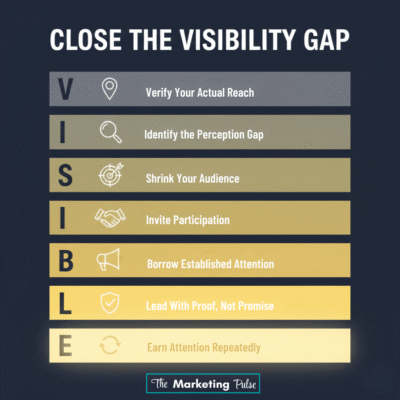
The VISIBLE Framework: How to Close the Gap
When you’re stuck assuming people see you when they don’t, you need a systematic way to earn attention instead of hoping for it.
-
V – Verify Your Actual Reach
Stop guessing. Measure where you actually show up, not where you think you show up. Google+ tracked sign-ups but ignored the real metric: active use. 90 million accounts meant nothing when nobody was posting.
Ask yourself: “Where is my audience spending their time right now, and am I actually there?”
-
I – Identify the Perception Gap
What you think you’re saying versus what people actually hear—there’s usually a canyon between them. Google thought they were building “a better social network.” Users thought they were being forced to abandon platforms they already loved.
Ask yourself: “If I asked 5 people in my target audience what my brand does, would they all say the same thing?”
-
S – Shrink Your Audience
Trying to be visible to everyone makes you invisible to everyone. Google+ tried to compete with Facebook, Twitter, and LinkedIn simultaneously. They should have focused on one specific audience with one specific unmet need.
Ask yourself: “Who is the ONE person who needs this most urgently right now?”
-
I – Invite Participation
Visibility isn’t about broadcasting. It’s about creating reasons for people to engage. Google+ forced integration but gave users no compelling reason to participate. Meanwhile, Facebook thrived because people’s friends were already there, creating organic reasons to engage.
Ask yourself: “What can my audience do, share, or say that makes them part of the story?”
-
B – Borrow Established Attention
Don’t start from zero. Go where attention already exists. Google tried to force attention by integrating Google+ into every product. Real borrowing means adding value where users already are, not dragging them somewhere new.
Ask yourself: “Who already has my audience’s attention, and how can I add value there?”
-
L – Lead With Proof, Not Promise
People don’t believe claims. They believe evidence. Google promised a “better social experience” but never showed why it was better or proved it solved real problems. No proof, just promises.
Ask yourself: “What’s the fastest way to show this works instead of saying it works?”
-
E – Earn Attention Repeatedly
Visibility isn’t a one-time event. It’s a habit. Google+ relied on their massive launch and forced integrations. When that didn’t create sustained engagement, they had no plan to earn attention over time.
Ask yourself: “Am I showing up consistently where it matters, or hoping one big push will do it?”

The Truth About Visibility
You don’t have an awareness problem. You have an assumption problem.
You assumed people would see you. They didn’t. You assumed visibility meant value. It doesn’t.
Google+ had Google’s entire ecosystem and forced visibility. They still failed because they never closed the gap between being seen and being valued.
The VISIBLE framework doesn’t guarantee success. But it guarantees you’ll stop shouting into the void hoping someone notices.
Visibility without relevance is just noise. And nobody remembers noise.
Now you know how to earn attention instead.
Next Steps
- Sign up for The Marketing Pulse for real-world strategy insights, examples, and execution-ready takeaways.